
ETF Types Explained: A Practical Guide to the 8 Main Kinds of ETFs in 2026
A practical guide to the eight main kinds of ETFs, from index funds to leveraged products, with the costs, risks and 2026 data investors should know.
Reference information only. This article is not investment advice, a recommendation, or a solicitation to buy or sell any security. Every investment can lose money. Figures may already be out of date. Check each fund's prospectus and consider your own situation before acting.
The ETF market in 2026
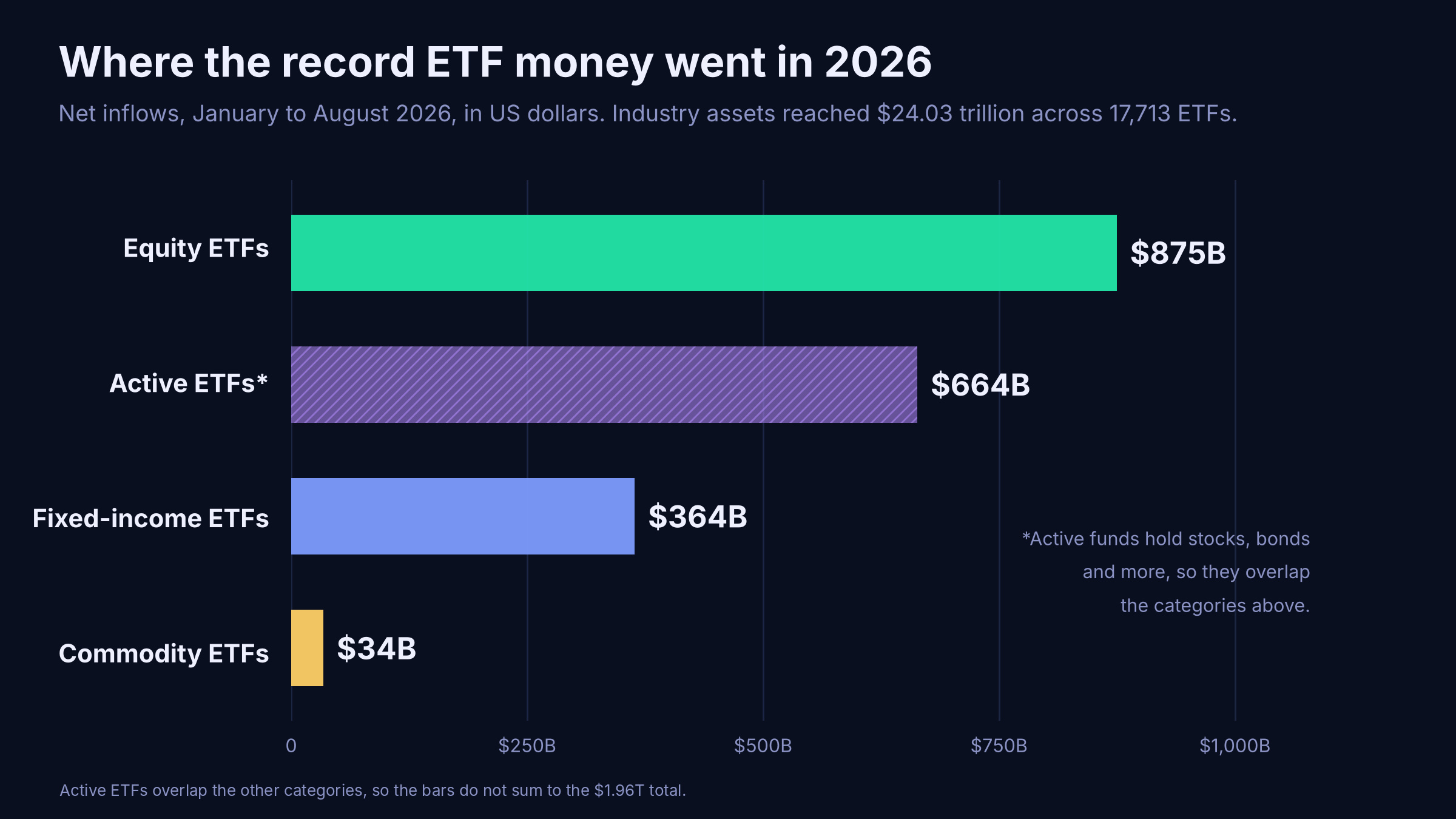
Exchange-traded funds are no longer a niche product. Global ETF assets reached $24.03 trillion at the end of August 2026, spread across 17,713 funds, and year-to-date net inflows of $1.96 trillion are already a record. In June, Vanguard's S&P 500 ETF (VOO) became the first ETF to pass $1 trillion in assets.
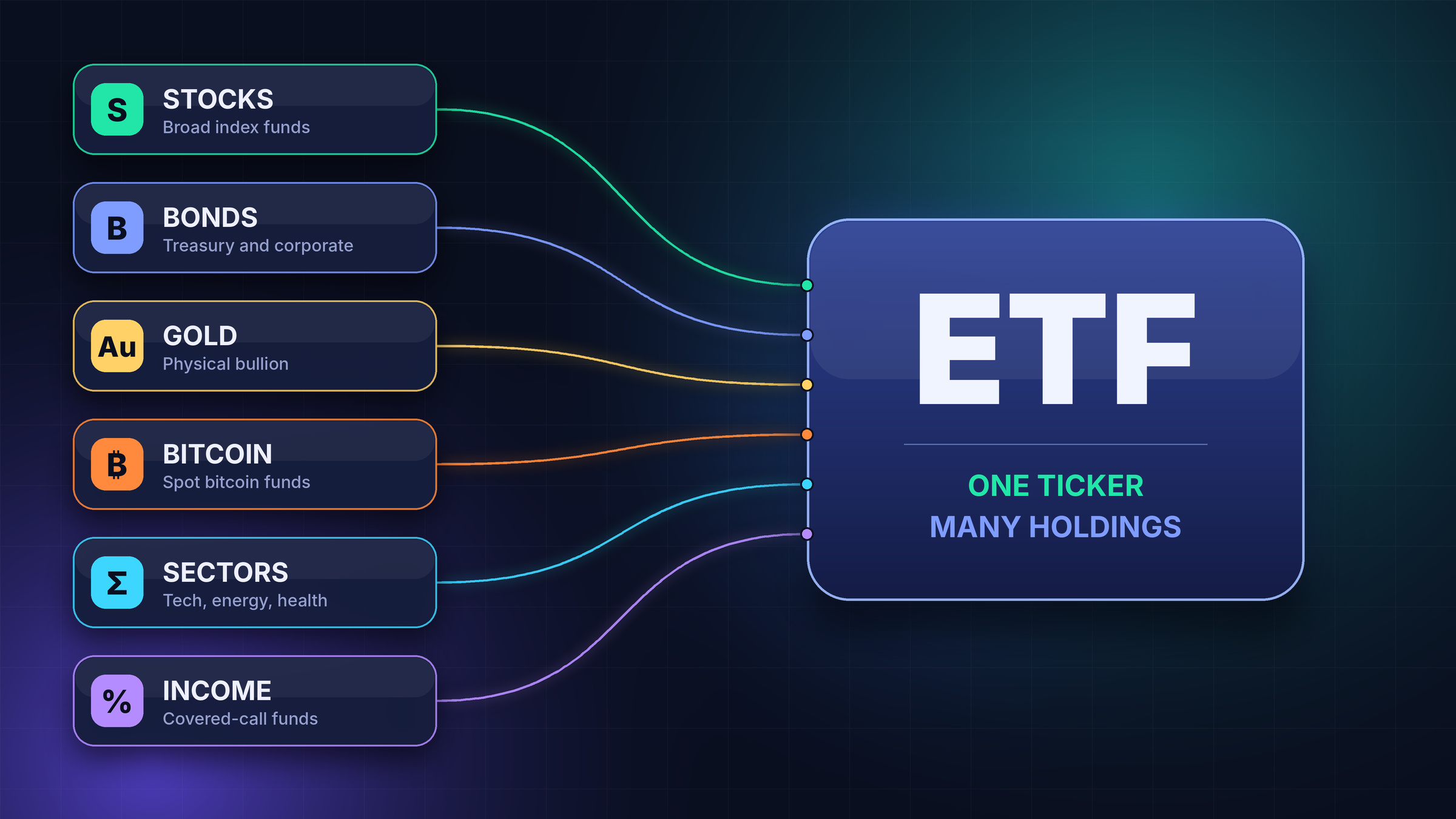
The label "ETF" describes a wrapper, not an investment. A bond ETF, a gold ETF and a 3x leveraged ETF share a ticker symbol and little else. The money is also not moving evenly, as the chart shows.
How an ETF works in 60 seconds
An ETF holds a basket of assets and sells shares in that basket on a stock exchange. You buy and sell during the trading day at a market price, just like a stock.
The mechanism that keeps that price honest is creation and redemption. Large institutions called authorized participants deliver a basket of the underlying securities to the issuer and receive new ETF shares in return. If the ETF trades above the value of its holdings (its net asset value, or NAV), they create shares and sell them, which pushes the price down. If it trades below NAV, they buy shares and redeem them, which pushes the price up.
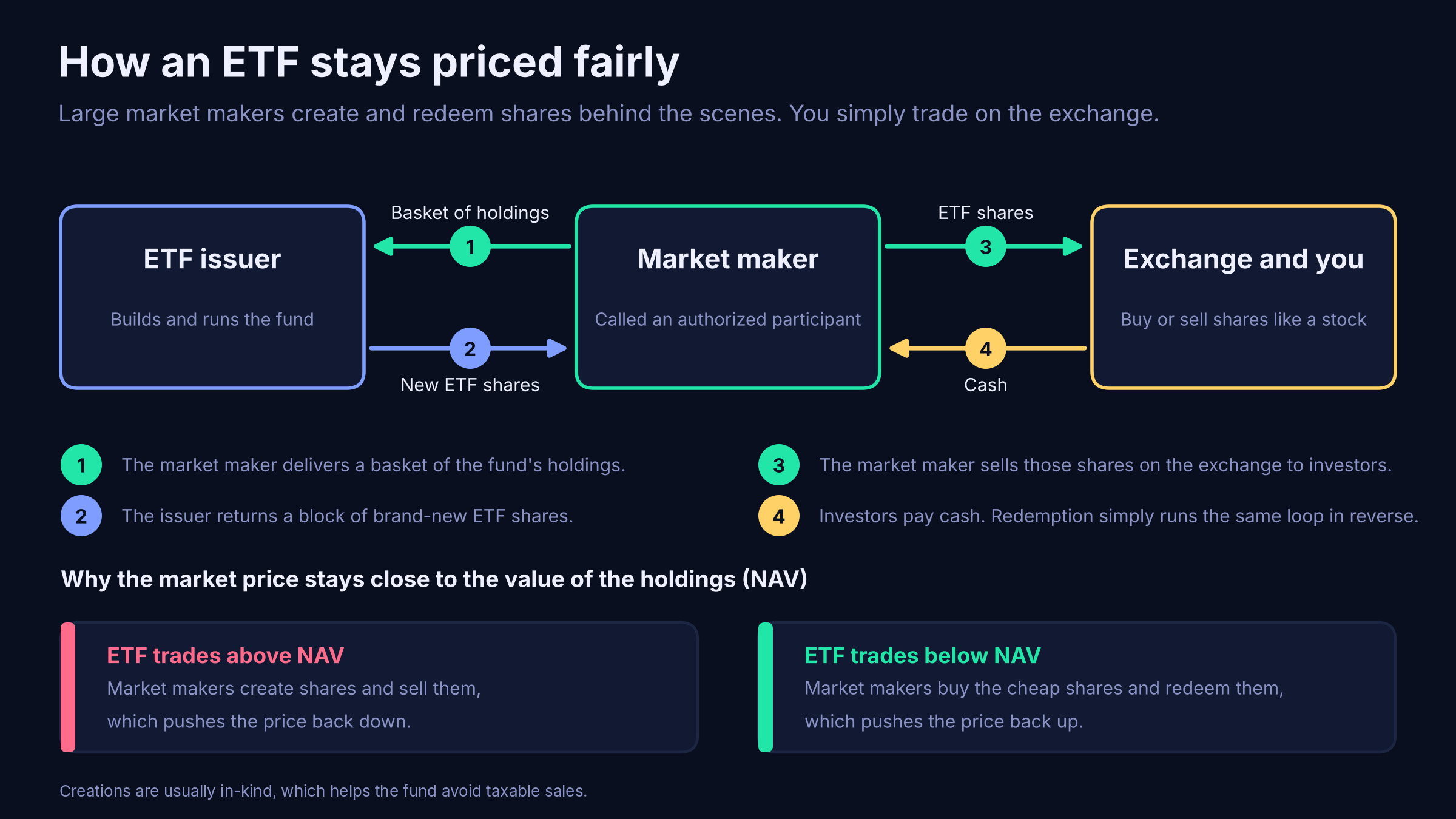
Because these swaps are usually made in kind (securities for shares rather than cash), the fund avoids many taxable sales, which supports its tax efficiency. Market makers also absorb most of the trading costs of creating and redeeming shares, instead of passing them to existing shareholders.
The eight ETF types at a glance
| Type | What it holds | Example tickers | Cost signal | Main risk |
|---|---|---|---|---|
| Broad index | Stocks across a whole market | VOO, IVV, SPY | 0.03% to 0.09% | Market drawdowns |
| Bond | Government and corporate debt | AGG, BND, TLT, IEF | 0.03% for AGG and BND | Rising interest rates |
| Commodity and gold | Physical metal or futures | GLD, IAU | 0.25% to 0.40% | Price swings, no income |
| Sector and thematic | One industry or idea | Semiconductor, energy, health funds | Varies by fund | Concentration |
| Covered-call income | Stocks plus sold call options | JEPI, JEPQ, QYLD | 0.35% to 0.60% | Capped upside |
| Active | A manager picks the holdings | Funds from Dimensional, J.P. Morgan, iShares | Varies by manager | Manager underperformance |
| Spot crypto | Bitcoin held by a custodian | IBIT, FBTC | 0.25% | Extreme volatility |
| Leveraged and inverse | Derivatives that multiply a daily move | TQQQ, SQQQ | Near 1% | Daily-reset decay |
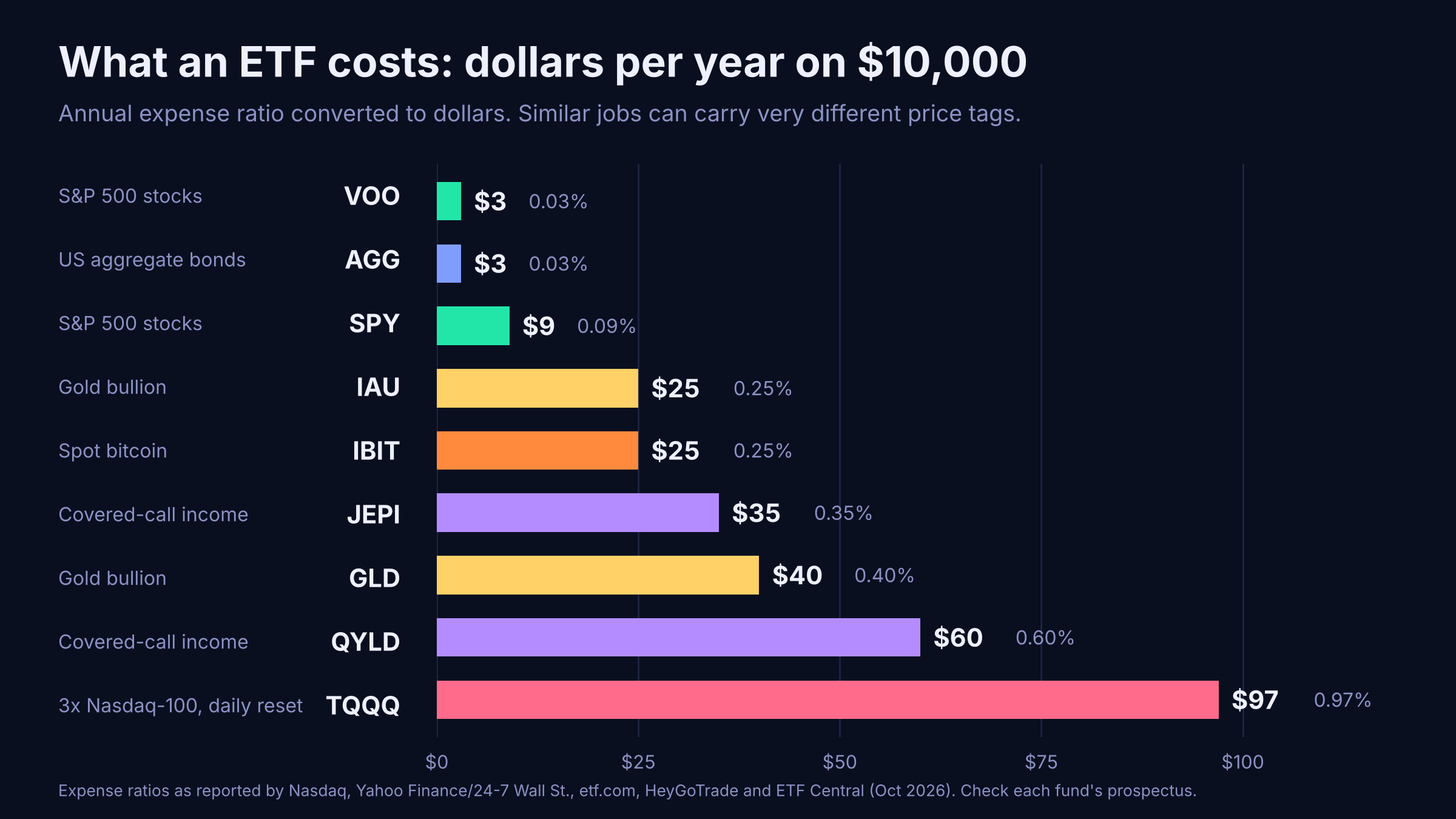
Cost is the one variable you can control with certainty, and the spread is wide. On a $10,000 position, the cheapest funds above cost about $3 a year and the leveraged fund about $97.
1. Broad-market index ETFs: the core
These funds track a market index such as the S&P 500 or a total-market benchmark, and they are the foundation of most ETF portfolios. Three funds dominate the S&P 500 category: VOO at roughly $1 trillion, IVV at about $860 billion and SPY at about $785 billion as of early June.
They look interchangeable but are not quite. VOO and IVV charge 0.03%, while SPY charges 0.09%. That is $3 versus $9 a year per $10,000, and the gap compounds. Trading volume matters too: higher volume tends to narrow the bid-ask spread, which lowers the cost of getting in and out.
Variants include total-market, international, dividend and factor funds. They change what you own, but not the logic: cheap, diversified and transparent.
Watch for: index funds are market-cap weighted, so the largest companies drive returns. Diversification across 500 names is not the same as diversification across weights.
2. Bond ETFs: income with a rate-sensitivity dial
Bond ETFs hold portfolios of government or corporate debt. They drew $364 billion of net inflows through August 2026, and the backdrop explains why: the 10-year Treasury yield stood at 5.15% on October 19.
The key number is duration, a measure of price sensitivity to interest rates. As a rule of thumb, a fund's price moves about its duration in percent for each 1-point change in yields. TLT, a long-Treasury fund, has an effective duration near 16.5 years. IEF runs roughly 7 to 8 years and AGG about 6.
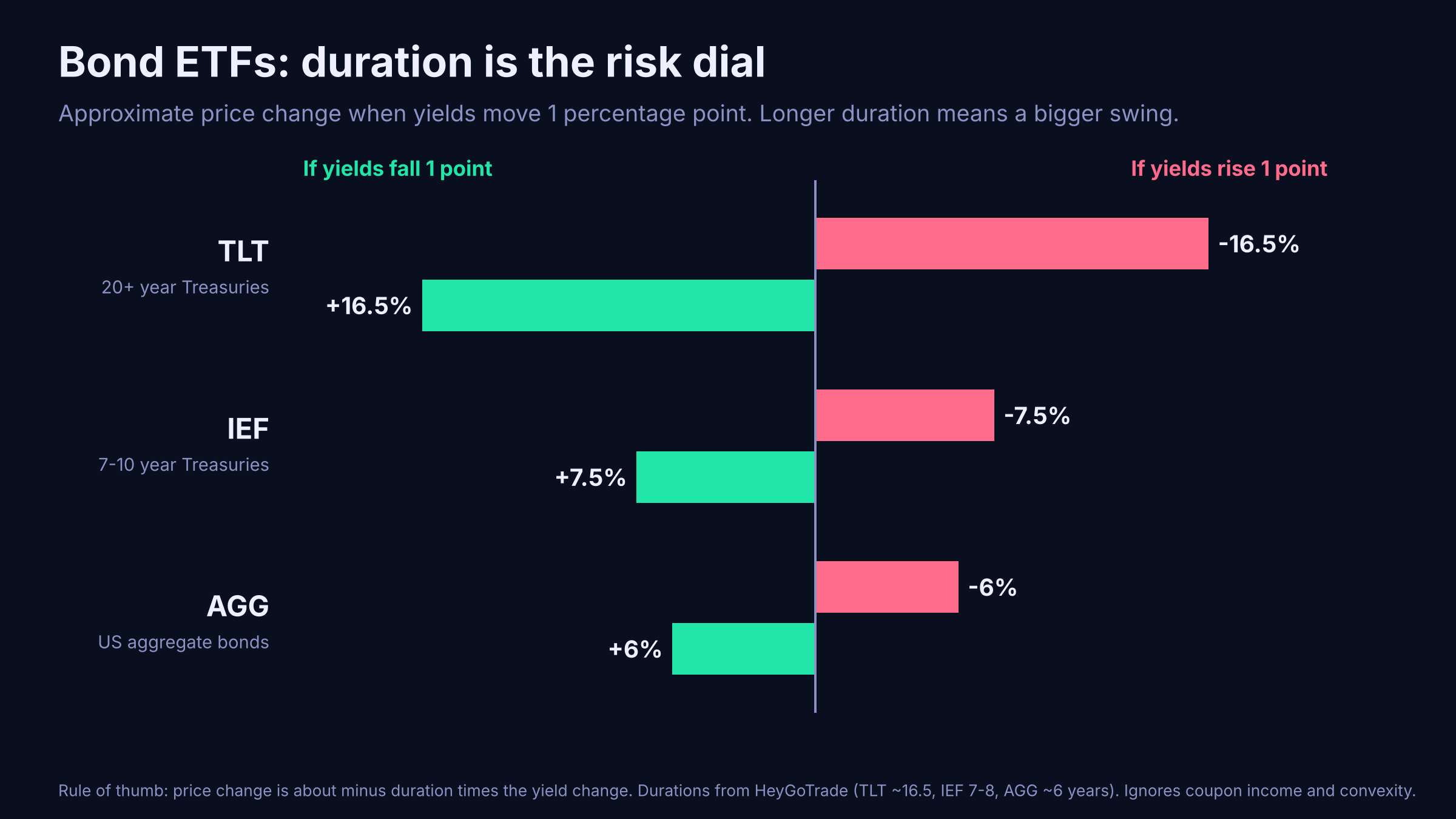
One structural point surprises many investors. An individual bond returns par at maturity. A bond ETF never matures, because the fund keeps rolling into new bonds, so there is no date on which you are guaranteed your principal back.
Watch for: duration mismatch. Matching the fund's duration to your time horizon matters more than chasing the highest yield.
3. Commodity and gold ETFs: the hedge that pays nothing
Gold ETFs let you hold bullion exposure in a brokerage account. As of October 19, GLD held $141.2 billion and IAU $61.8 billion. The two track the same asset, but GLD charges 0.40% and IAU 0.25%.
Commodities remain a small slice of ETF flows, with $34 billion of net inflows through August against $875 billion for equities. Gold earns its place by behaving differently from stocks and bonds, not by producing income. It pays no dividends or interest, so its return depends entirely on price.
Watch for: structure and tax. Physical-metal funds and futures-based commodity funds work differently, and in the US physical-metal funds are generally taxed as collectibles. Check the fund's own documents.
4. Sector and thematic ETFs: concentrated bets
Sector funds track one industry such as energy or health care. Thematic funds track an idea such as robotics or semiconductors. They are convenient, but narrow.
A Morningstar study of European thematic funds (published in 2018, but the logic still holds) found they tend to hold smaller stocks and show higher volatility than the broad market. Some carry persistent factor tilts, such as technology funds favoring growth and momentum stocks, which can mean long stretches of underperformance. Morningstar's conclusion was that they work best as satellite holdings.
Watch for: overlap. If you already own an S&P 500 fund, a technology sector fund adds more of what you hold. Read the top 10 holdings of both before buying.
5. Covered-call income ETFs: yield in exchange for upside
These funds hold stocks and sell call options against them. The option premiums are paid out as distributions, usually monthly. The trade-off is built in: in a sharp rally, gains above the option's strike price go to the option buyer.
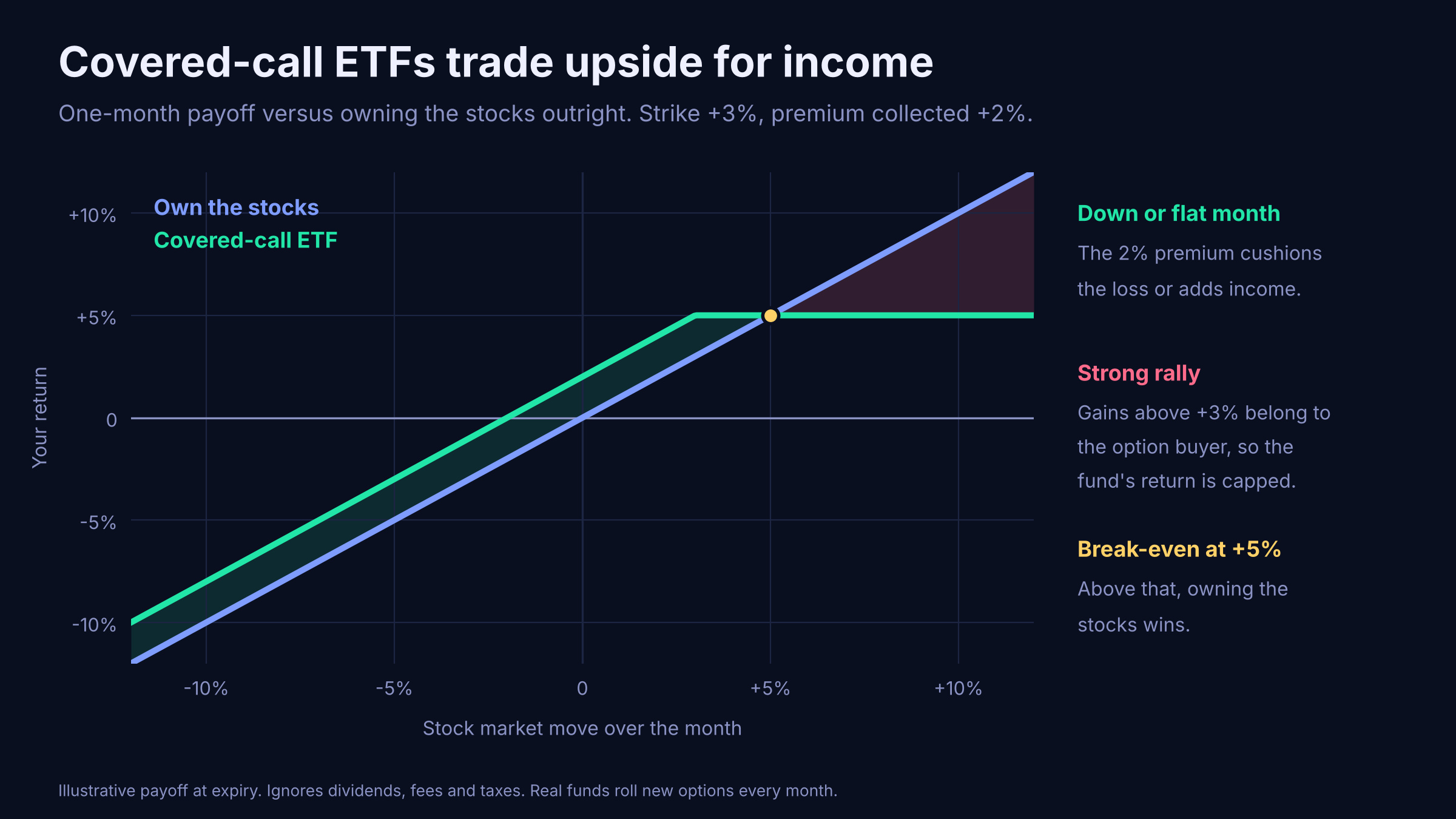
The real-world numbers match the shape of that chart. JEPI, with about $45.6 billion in assets and a 0.35% fee, fell 3.5% in 2022 when the S&P 500 dropped 18%, but returned just under 10% in 2023 when the S&P 500 gained 26%. QYLD, which sells at-the-money calls, returned about 7% annualized over the five years through March 2026, against about 17% for the Nasdaq-100, despite a yield near 12%.
Watch for: judge these funds on total return, not yield. Distributions can be taxed as ordinary income. The etf.com piece puts a roughly 8.4% JEPI yield at about 5.7% after federal tax for an investor in the 32% bracket.
6. Active ETFs: a manager inside the wrapper
Active ETFs do not track an index. A manager chooses the holdings, but the fund still trades on an exchange. This is the fastest-growing corner of the market: active ETF assets hit a record $2.59 trillion at the end of July, with $590 billion of inflows in seven months. Dimensional, J.P. Morgan and iShares took about a quarter of those flows.
"Active" tells you who makes the decisions, not whether the decisions are good. Judge an active ETF on the same three things as any manager: fees against a comparable index fund, a track record through more than one market regime, and how clearly the strategy is explained.
Watch for: paying a premium fee for a portfolio that behaves like an index.
7. Spot bitcoin ETFs: crypto without the wallet
Spot bitcoin ETFs hold actual bitcoin with a custodian. You own shares in the fund, not coins. IBIT and FBTC both charge 0.25%. With bitcoin near $82,000 on October 18, the flows show how two-sided demand is: through October 19, the funds had net outflows of $90.6 million for the month, even though October 19 alone brought in $526.6 million, the largest single day.
An ETF gives you price exposure and a familiar brokerage account. It does not give you staking, self-custody or exposure to the smaller tokens. For that angle, see our look at crypto tenbagger candidates for 2027 and the tokens that follow the cash flow.
Watch for: volatility. A low expense ratio does not make the underlying asset less volatile.
8. Leveraged and inverse ETFs: trading tools, not investments
Leveraged ETFs aim to deliver a multiple, often 2x or 3x, of an index's return for a single day. Inverse ETFs aim for the opposite. The key phrase is "for a single day." Because the fund resets daily, returns over longer periods can differ sharply from the index, especially in volatile markets.
The SEC and FINRA have warned about this directly. In their example, from December 2008 to April 2009, a 3x leveraged fund on a financial-services index fell 53% while the index gained about 8%, and a 3x inverse fund fell 90%. FINRA's John Gannon called them a "minefield for buy-and-hold investors."
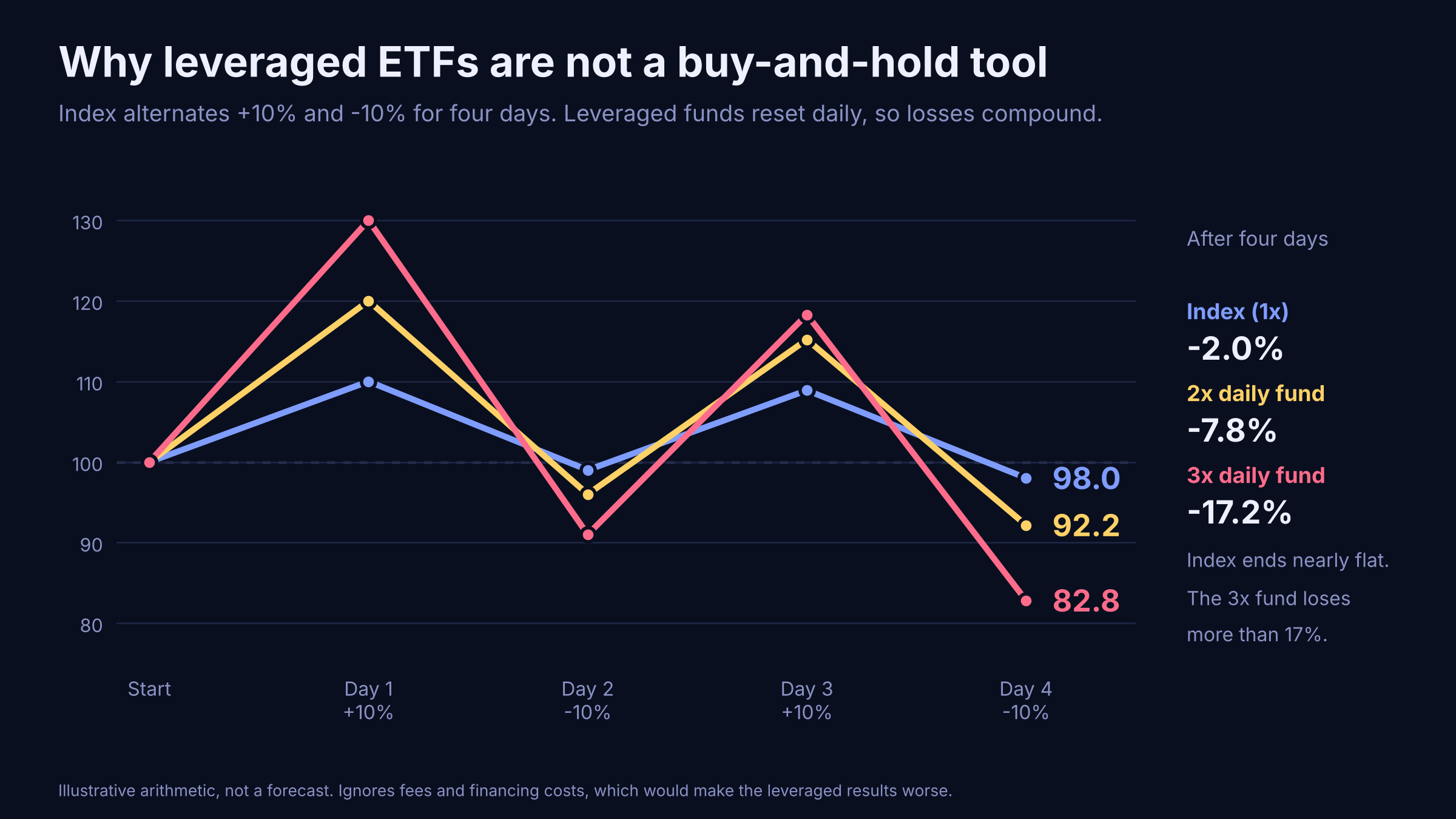
The popularity is real. TQQQ, a 3x Nasdaq-100 fund, holds about $35 billion and charges 0.97%. The chart above is simple arithmetic, not a forecast, and it ignores fees that make real results worse.
Watch for: holding period. These products are built for short-term tactical use by investors who monitor them daily.
How to choose: five checks before you buy
Most ETF portfolios work best as a core and satellite structure: broad stock and bond index funds as the core, with smaller positions in gold, sectors or income funds, and the riskiest products kept to an amount you can lose. Before adding any fund, check five things:
- Expense ratio. Compare it with the cheapest fund that does the same job.
- What it holds. Read the fact sheet and top holdings, not just the name.
- Liquidity. Check average volume and the bid-ask spread, especially for smaller funds.
- Structure and tax. Know whether you own bullion, futures, derivatives or a note, and how distributions are taxed.
- Role in your plan. If you cannot say what job the fund does, do not buy it yet.
Bottom line
ETFs are a low-cost, transparent way to own almost any market, but the eight types carry very different risks. Index and bond funds are building blocks. Gold, sector and income funds are specialists. Active, bitcoin and leveraged funds demand the most scrutiny. The ticker tells you how it trades. The holdings tell you what you own.
Disclaimer: This article is reference information only. It is not investment advice, a recommendation, or a solicitation to buy or sell any security. Investments can lose value, and past performance does not predict future results. Do your own research or consult a licensed adviser.