
Follow the Cash Flow: 4 Crypto Tokens Where Protocol Revenue Meets a Real Catalyst (Oct 2026)
We screened crypto tokens on revenue that actually reaches holders, valuation versus peers, growth and catalysts. Four stand out, and several popular names fail the test.

For information only. This is not investment advice or a recommendation to buy or sell anything. Crypto assets are extremely volatile and can lose most or all of their value. Figures may already be out of date. Do your own research.
Why we stopped looking at market cap
Our first list of 2027 candidates started from narratives and market-cap room. That is a weak screen: a small market cap says nothing about whether a business earns money or whether the token captures any of it. This time we started from the cash flow.
The question is simple. Does the protocol earn real revenue, and does that revenue reach the token? Many do not. A recent screen by TechFlow, which began with the top 300 tokens and kept only 38 that retain revenue, excluded Morpho, Ondo, Celestia, The Graph and EigenCloud for exactly that reason.
How we screened
We combined two public screens and added our own checks.
- Revenue the protocol keeps. Grayscale ranked 15 on-chain protocols by trailing 12-month revenue using DefiLlama and Artemis data.
- Cheap versus peers, with growth. TechFlow required a valuation below the sector median, revenue growth above it, and a price that had lagged, then stripped out one-day revenue spikes.
- A dated catalyst or a clear mechanism. A merger, a buyback, a fee switch. Not a story.
- A named way it fails. If we could not write down what breaks the case, the token did not make the list.
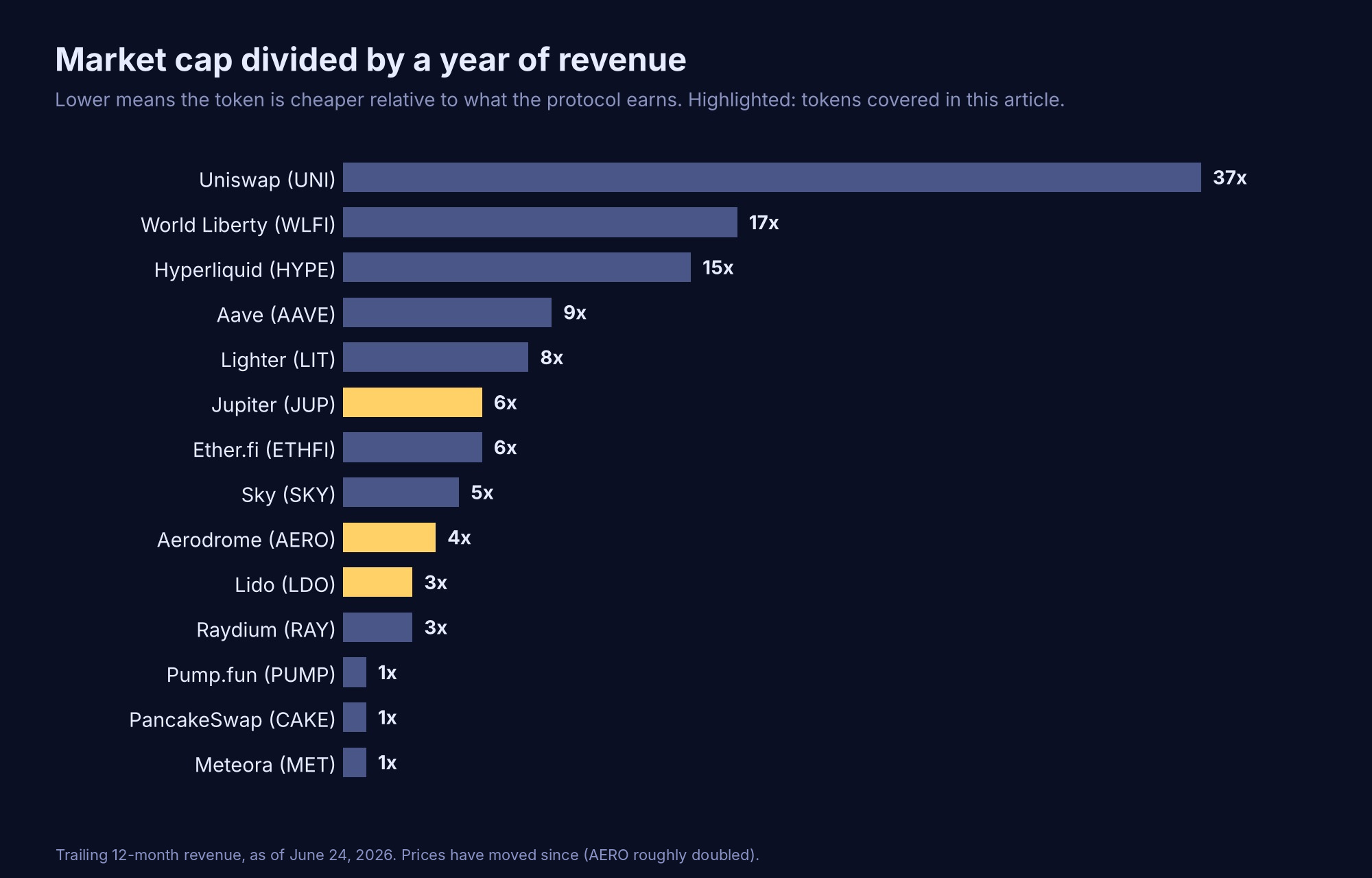
Context matters too. Bitwise reports that the market has had three straight negative quarters and that its large-cap index fell 15.4% last quarter, while the industry itself is about twice as large as at the last cycle's bottom. Prices have lagged usage. That gap is what a revenue screen tries to find.
The four tokens
| Token | Why it passed | Dated catalyst | What breaks it |
|---|---|---|---|
| Aerodrome (AERO) | 4x revenue in June; team promises 100% of revenue to holders | Aerodrome and Velodrome merge into AERO on October 21 | Already up about 71% in 30 days; promises are unverified |
| Jupiter (JUP) | $130M trailing revenue; 30-day revenue up 44% | Ongoing buybacks | Growth partly tracks Solana's price |
| Lido (LDO) | 3x revenue in June; near its all-time low | Buyback of up to about $20M | No direct value flow to LDO; market share falling |
| Morpho (MORPHO) | $6.7B deposits | Possible fee switch; Apollo purchase deal | Zero revenue to holders today; large unlocks |
Aerodrome (AERO): a merger with a date
Aerodrome and Velodrome plan to merge into one protocol, Aero, going live on October 21 across seven EVM chains including Base, Ethereum, Optimism and Arbitrum. Holders convert at 1 AERO per AERO and about 0.044 AERO per VELO. The two protocols already handle about 17% of EVM trading volume, and the team says it expects to triple that share and pay 100% of revenue to AERO holders.
On Grayscale's June 24 data, Aerodrome earned $124M a year against a $471M market cap, about 4x. That was the cheap part. By October 11 the market cap had reached about $947M after a 71% gain in 30 days, which on the same revenue is roughly 7.6x. The token is still about 60% below its December 2024 high of $2.33, but the easy re-rating has partly happened.
What breaks it: the team's tokenomics and the 100% revenue claim are not independently verified, and technical indicators on October 11 showed an overbought, extended price.
Jupiter (JUP): the one that passed the stress test
Jupiter was one of only two protocols to pass all of TechFlow's filters, including the check for one-day spikes. Its 30-day revenue was $6.4M, up 44%, with about 34% of fees retained, and its price had lagged. Grayscale puts trailing revenue at $130M against a $716M market cap, about 6x. A recent price snapshot shows JUP near $0.31 with a market cap around $1.04B and a fully diluted value of $2.2B, against an all-time high of $2.00. The snapshot is undated, so check a live quote.
What breaks it: TechFlow notes that part of the growth likely reflects Solana's own rally. If Solana activity fades, revenue fades with it. The FDV is more than twice the market cap, which means supply still has to be absorbed.
Lido (LDO): the turnaround that may never turn
This is the contrarian pick and the weakest case on the list. LDO traded near $0.32 at the end of March, about 95.6% below its 2021 high, with a market cap of about $272M. The DAO approved a buyback of up to about $20M, roughly 7% of the market cap.
The same analysis lists the problems: 2025 protocol revenue of $37.4M, down 23%; market share of staked ETH down from over 28% to about 21%; and no direct mechanism that sends revenue to LDO holders. (Revenue definitions differ between data providers, so other tallies show a larger number.)
What breaks it: everything above. A buyback helps only if revenue stabilizes and the token is given a real claim on it.
Morpho (MORPHO): an option on one governance vote
Morpho had $6.7B in deposits and about $121M in annualized fees in March, but zero revenue reaching token holders, because the fee switch (up to 25% of interest) has never been proposed. The thesis is simply that it might be. Apollo also announced a deal to potentially acquire up to 90M MORPHO over 48 months.
What breaks it: 123.9M more tokens unlock over the following 12 months, about a 22.6% increase in supply, and governance is concentrated in a few delegates. This data is from March, so it is the oldest on the list.
Popular names that failed the screen
Screening out is as informative as screening in.
- Pump.fun (PUMP): a strong business, but at about $2.51B market cap on October 10 it sits near 5x extrapolated annual revenue, and revenue fell 16% from its October 5 peak. A 10x would need roughly $25B.
- Lighter (LIT): revenue peaked near $14M a month in November 2025 and cooled to roughly $2 to $3M. Team and investor tokens begin unlocking on December 27, 2026.
- Bittensor (TAO): about $17M of annualized revenue against a $2.4B market cap in May, and a major subnet operator left in April.
- Collector Crypt, Jito, Bonk, Aethir: cheap-looking on one measure, but revenue fell by a third, retained revenue was about 73x, a 57% gain became a 17% decline once spike days were removed, or 65% of a month's revenue came from a single day.
What a 10x would actually need
A price move is revenue growth multiplied by a change in valuation. For AERO at roughly $947M, a 10x means about $9.5B. That could mean revenue tripling and the revenue multiple rising from about 7.6x to over 25x, a level only Uniswap reaches on the chart above. For LDO the arithmetic is gentler, but it needs a structural change in how the token earns.
That is why we do not call any of these a likely tenbagger. A revenue screen finds tokens whose cash flows may be mispriced, which is a more repeatable idea than hunting for a 10x. If one of them does multiply, it will probably be because revenue grew and the market agreed to pay more for each dollar of it, and both have to happen.
A short checklist before acting on any of this
- Check a live price and market cap. Several figures here are weeks or months old.
- Read the token's actual rights. Revenue to the protocol is not revenue to you.
- Look at the unlock calendar before any buy.
- Size positions so that a total loss is survivable.
Disclaimer: This article is for information only and is not financial advice. It does not recommend buying or selling any asset. Crypto assets are volatile and can lose most or all of their value.