
Top 10 Memecoins to Watch in October 2026: DOGE, PEPE, BONK, SNEK and More
A fact-based look at ten memecoins as of October 20, 2026, including Cardano's Snek: size, liquidity, distance from all-time highs, supply design and the risks behind each.
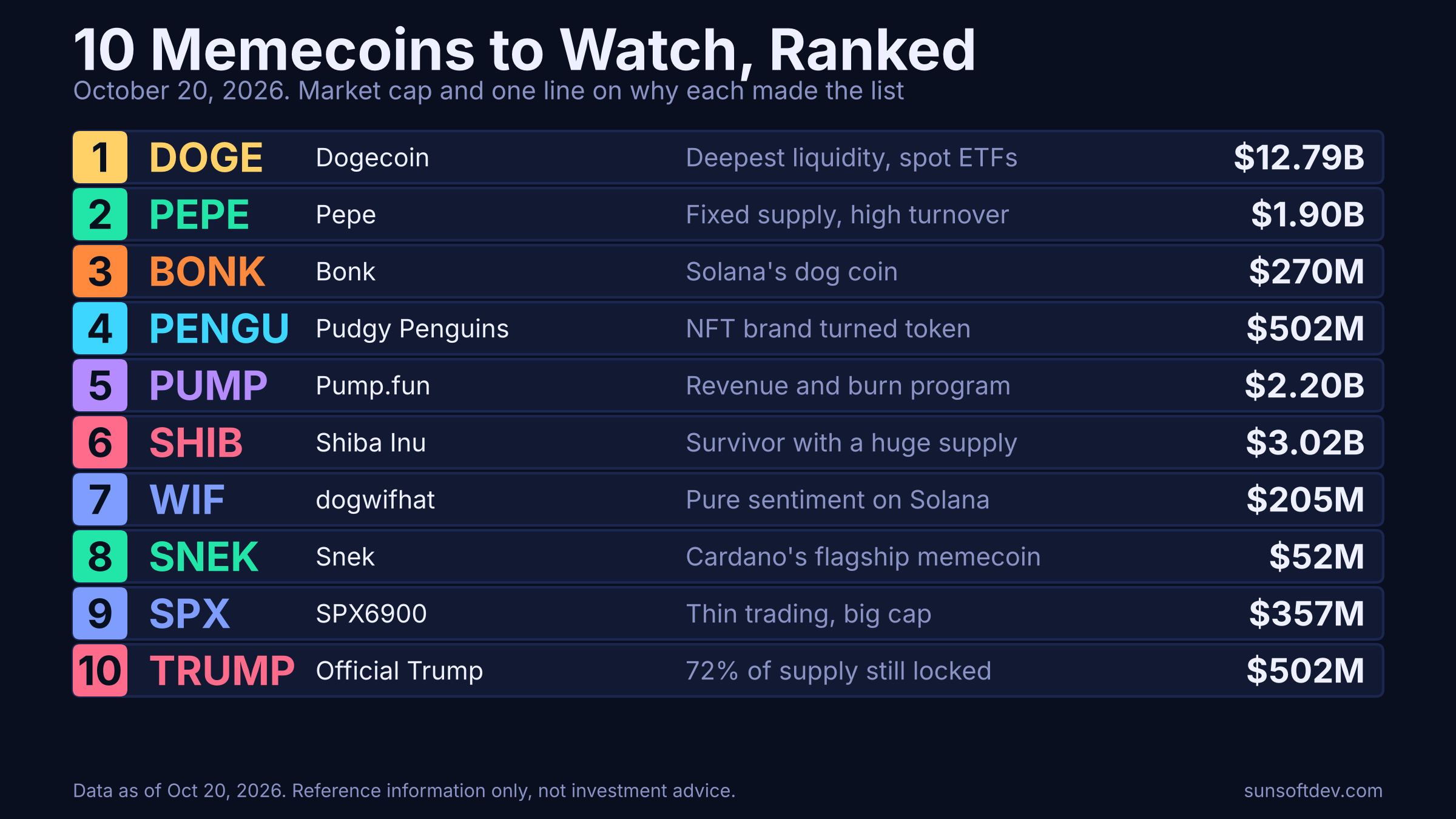
Reference information only. This article is not investment advice, a recommendation, or a solicitation to buy or sell any crypto asset. Memecoins are among the most volatile and speculative assets in any market. Many have lost 90% or more of their value, and some go to zero. Never put in money you cannot afford to lose. Figures are a snapshot from October 20, 2026, and change by the minute.
Memecoins are the loudest corner of crypto and one of the hardest to analyze. There are no earnings, no cash flows and, in most cases, no product. What you have is a story, a supply schedule, a trading venue and a crowd. This guide goes through ten memecoins that stand out right now, including Snek (SNEK) on Cardano, and tries to answer three plain questions for each: how big is it, how easy is it to trade, and what could go wrong.
The list is an editorial selection, not a price forecast. We picked coins that are large, liquid, culturally recognizable or built around a clear mechanism, then scored them on four practical questions so the comparison stays honest.
How we picked and scored them
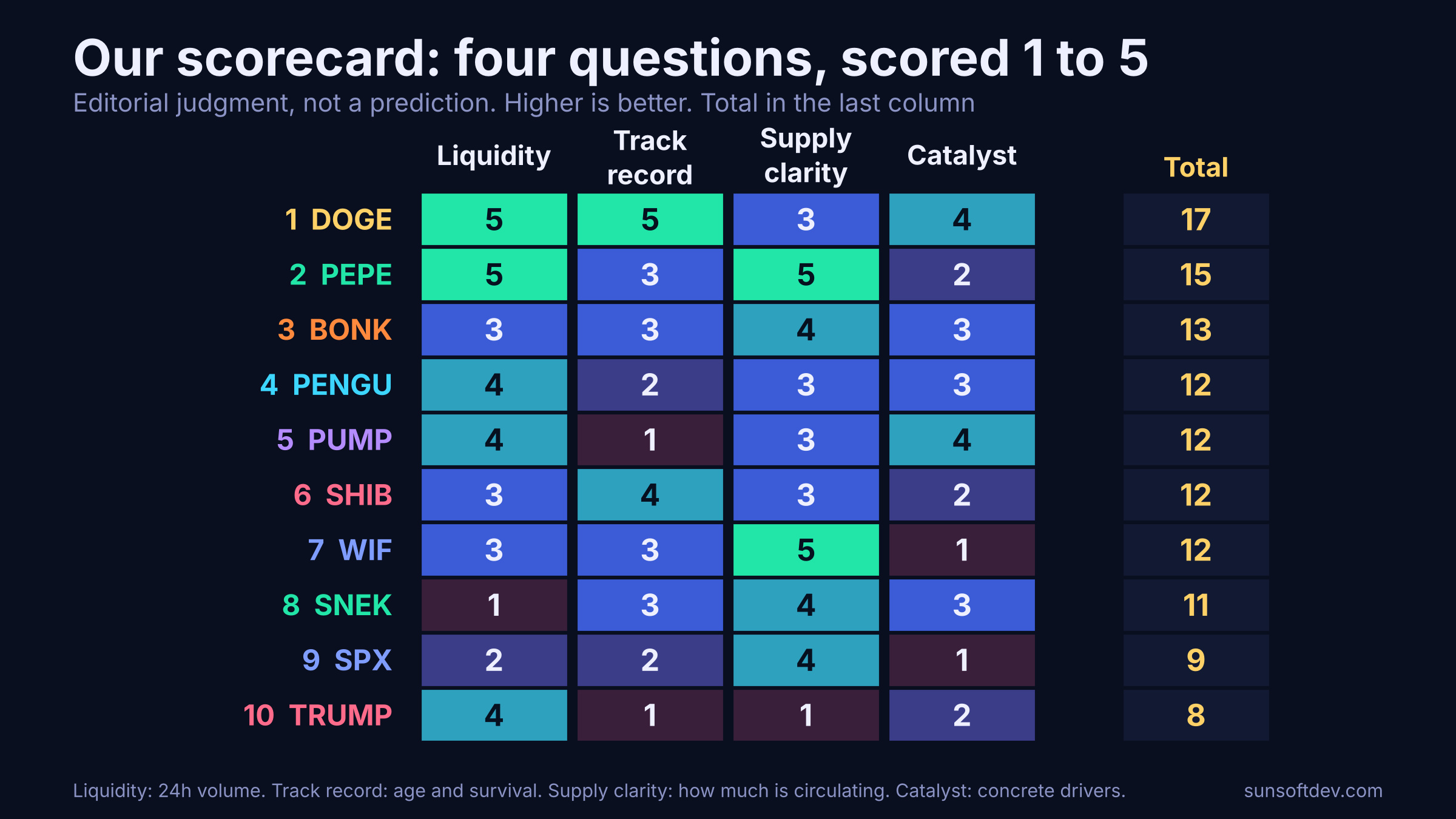
A memecoin cannot be valued the way a company can, so we scored each one on four questions. Each gets 1 to 5, and higher is better:
- Liquidity: Can you get in and out without moving the price? We looked at 24-hour trading volume.
- Track record: How long has it survived, and how many cycles has it been through?
- Supply clarity: Is the supply fixed and mostly in circulation, or is a large share still locked and waiting to unlock?
- Catalyst: Is there a concrete driver beyond hype, such as a product, ETF access, a revenue program or an ecosystem?
The scores are our judgment on the data we could check. They measure how a coin is built and traded. They do not measure how likely its price is to rise.
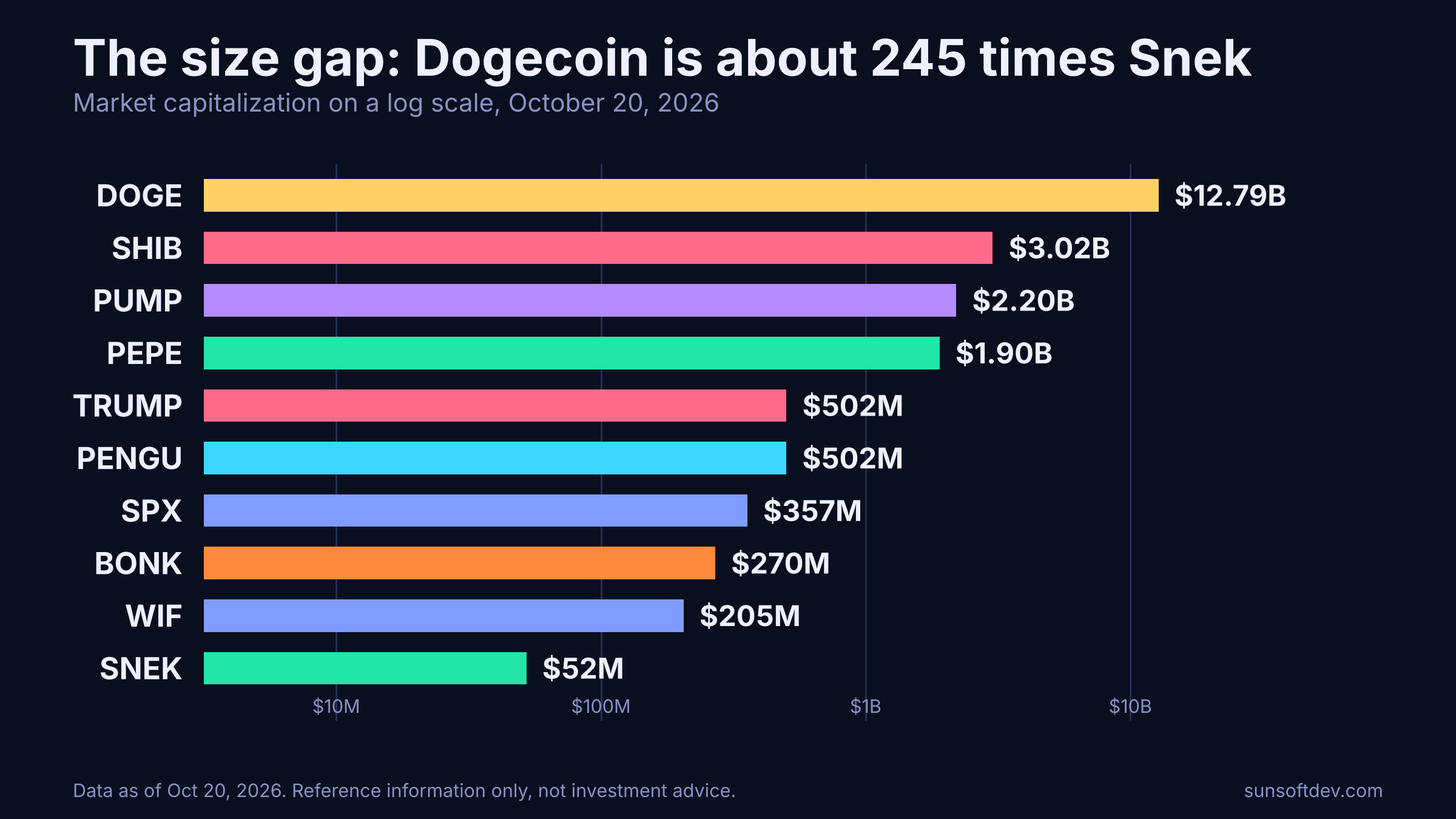
The market in one chart
The first thing to notice is how uneven this market is. Dogecoin alone is worth roughly 245 times Snek and about four times the next memecoin on our list. Below the top three or four names, the group is small by any serious market standard, and small markets move on small amounts of money.
The second thing is how far almost all of them sit from their peaks. Nine of the ten trade more than 80% below their all-time highs. Only Pump.fun's token, which is the youngest design on the list, is closer, at roughly 47% below its high. That is a reminder that memecoin rallies tend to be short and that most buyers at a peak are still under water.
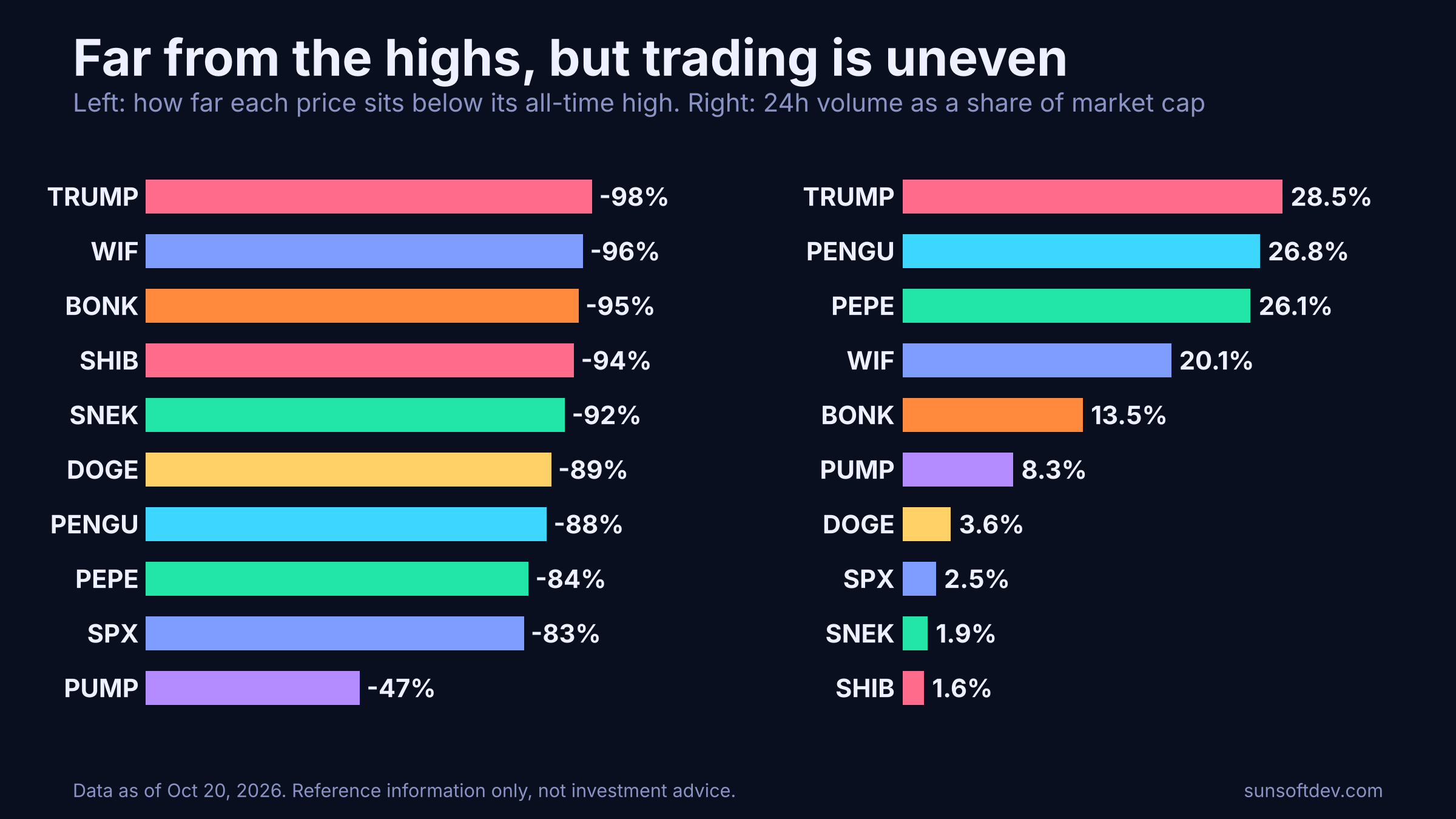
The right-hand chart shows turnover: daily volume as a share of market cap. High turnover (TRUMP, PENGU, PEPE) means an active crowd and easy trading, but also fast, speculative money. Low turnover (SHIB, SNEK) can mean a quiet holder base, or simply that few people are trading. Either way, thin volume makes large orders expensive to execute.
1. Dogecoin (DOGE): the benchmark
Market cap: about $12.8 billion. 24h volume: about $461 million. About 89% below its all-time high.
Dogecoin is the original memecoin and still the one everything else is measured against. It has the deepest liquidity in the category, listings on nearly every major exchange, and, notably, spot exchange-traded products in the United States that give traditional brokerage accounts a regulated way to hold it. That access is a real structural advantage no other memecoin on this list can claim to the same degree.
Two things to understand. First, DOGE has no fixed supply cap: new coins are issued continuously, which dilutes holders slowly over time. Second, its price still follows broad crypto sentiment and large-holder activity. Dogecoin scores highest on our card because it is the easiest to trade and has the longest record, not because it is immune to a 50% drop.
2. Pepe (PEPE): the purest meme on Ethereum
Market cap: about $1.9 billion. 24h volume: about $496 million. About 84% below its all-time high.
Pepe is built on a simple idea. It launched on Ethereum in 2023 as a pure meme with a fixed supply of 420.69 trillion tokens and no promised utility. That clarity is its strength: the supply is known, nothing is waiting to unlock, and nobody claims a product roadmap that could disappoint.
Its daily volume is about a quarter of its market cap, which is high for a coin of this size and shows an active trading crowd. The flip side is that PEPE has no earnings or revenue to anchor it. It moves with attention, and attention can leave quickly.
3. Bonk (BONK): Solana's community dog
Market cap: about $270 million. 24h volume: about $37 million. About 95% below its all-time high.
Bonk came out of Solana's late-2022 downturn as a community token distributed widely to Solana users and developers, and it became the unofficial mascot of that ecosystem. Its fortunes are tied to Solana's: when Solana activity and speculation rise, BONK tends to get attention, and when they fade, it fades.
It scores a middle 3 for liquidity and a 4 for supply clarity. Its main risk is the one all memecoins share: when a coin is 95% below its high, the next big move is not guaranteed to be up, and old holders sell into every rally.
4. Pudgy Penguins (PENGU): an NFT brand with a token
Market cap: about $502 million. 24h volume: about $134 million. About 88% below its all-time high.
PENGU is the token of the Pudgy Penguins brand, which began as an NFT collection and has pushed into toys, retail products and digital media. That gives it something most memecoins lack: a real consumer brand outside of crypto. Trading volume is about 27% of market cap, so it is easy to buy and sell.
The challenge is converting brand reach into lasting demand for the token itself. Selling toys does not automatically create buyers for PENGU. We scored its track record a 2 because the token is young and has not been tested through a full cycle.
5. Pump.fun (PUMP): the casino's own token
Market cap: about $2.2 billion. 24h volume: about $182 million. About 47% below its all-time high.
Pump.fun runs the platform where new Solana memecoins are launched in large numbers, so its token is a bet on the memecoin machine itself rather than on a single meme. The project has described a program that uses platform revenue to buy back and burn tokens, which is the most concrete mechanism on this list. That is why it earns a 4 for catalyst.
The risk is circular: if memecoin speculation cools, launches fall and revenue falls with them. It also has the shortest history here, hence a 1 for track record. It is the closest thing in this group to a business, and it is a business tied to the most speculative activity in crypto.
6. Shiba Inu (SHIB): the survivor with a giant supply
Market cap: about $3.0 billion. 24h volume: about $48 million. About 94% below its all-time high.
Shiba Inu was the best-known "Dogecoin killer" of the last cycle and has stuck around longer than most. It has an ecosystem around it, including its own network, and a loyal community. Its market cap is the second largest on our list.
But turnover is the lowest here, at under 2% of market cap per day, which suggests the crowd has mostly moved on. SHIB's supply is in the hundreds of trillions, so a "one cent" price would imply a market value far larger than the entire memecoin category. Anyone who sees the tiny price per token should read that as a supply issue, not as a bargain.
7. dogwifhat (WIF): sentiment, distilled
Market cap: about $205 million. 24h volume: about $41 million. About 96% below its all-time high.
WIF is a Solana memecoin with a fixed supply of about one billion tokens, which is small by memecoin standards. It is the cleanest example of a coin with no product and no roadmap, which is both its appeal and its main risk. When sentiment on Solana memecoins is strong, WIF often leads; when it is weak, it often falls hardest.
We gave it a 5 for supply clarity and a 1 for catalyst. There is nothing scheduled that should change its story, so price is likely to follow the mood of the market.
8. Snek (SNEK): Cardano's flagship memecoin
Market cap: about $52 million. 24h volume: about $1 million. About 92% below its all-time high.
Snek is the best-known memecoin on Cardano, and the one the Cardano community points to when the topic comes up. Cardano has a smaller DeFi and trading scene than Solana or Ethereum, and Snek reflects that: it is the smallest coin on our list by market cap and by liquidity.
What makes Snek interesting is its distribution. The project describes a fixed supply of about 76.7 billion tokens, split roughly 50% presale, 40% initial liquidity, 5% utility reserve, 3% for exchange listings and 2% for airdrops and giveaways, with nothing set aside for a team. Almost all of that supply, about 74.7 billion tokens, is already in circulation, so there is no large unlock schedule hanging over the market. That earns it a 4 for supply clarity, which is among the better scores on this list.
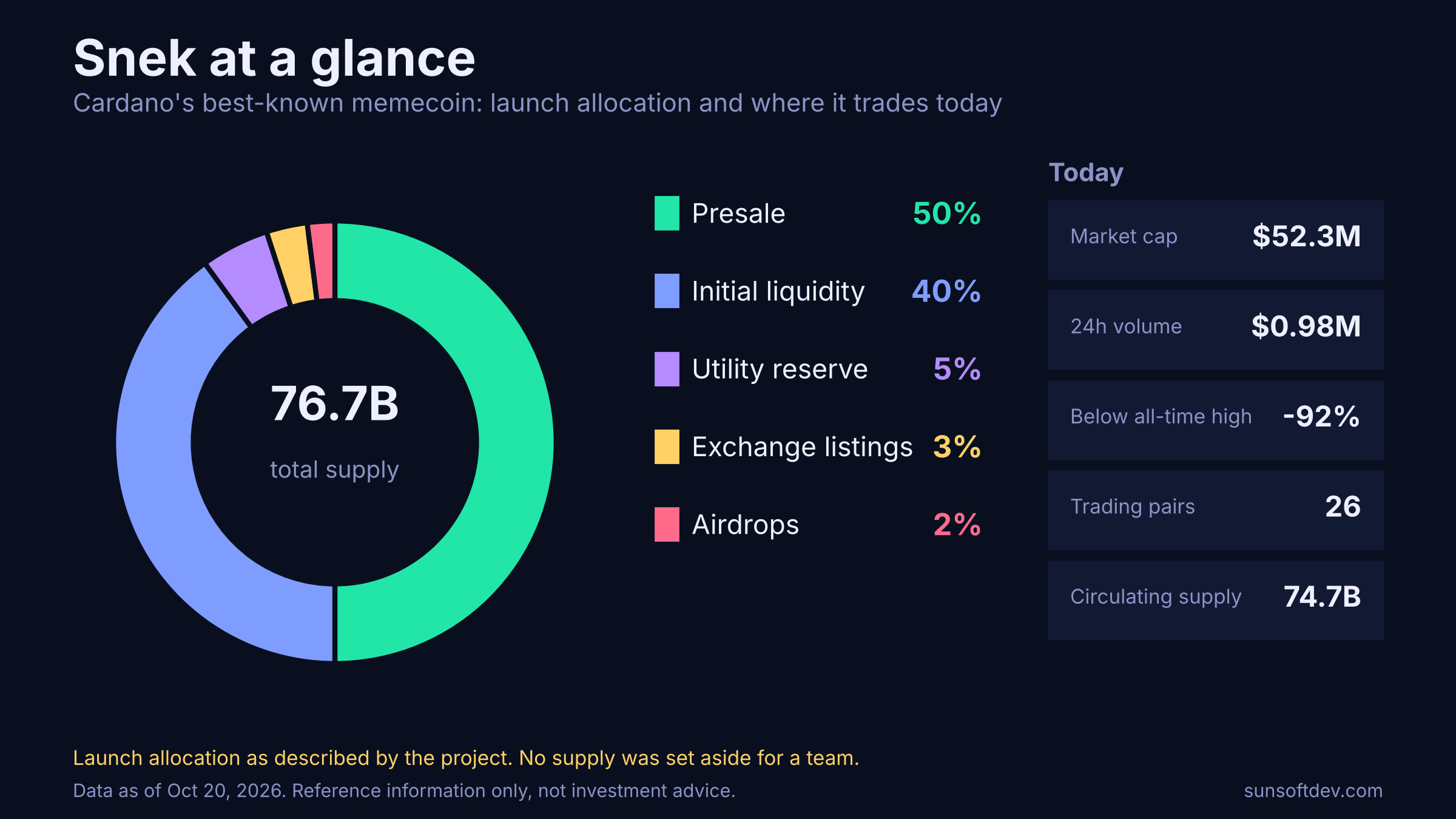
The trade-off is liquidity. With daily volume of about $1 million, a few large orders can move the price a lot, and exiting a big position can be expensive. That is why it scores a 1 for liquidity and lands eighth overall. Its fortunes are also tied to Cardano itself: community discussion has included a proposal to fund Snek-related work from the Cardano treasury, but the status of that proposal can change, so check the current state before relying on it. A rally in ADA tends to help the Cardano ecosystem, and a slump hurts it.
Two cautions specific to Snek. First, supply figures differ slightly between data sites, so verify the numbers on-chain before relying on any one page. Second, small-cap coins on smaller chains can be hit hard when a few holders sell. Snek is a useful case study of a community-driven memecoin with a transparent supply, and also a case study in how thin a market can be.
9. SPX6900 (SPX): the stock-market joke
Market cap: about $357 million. 24h volume: about $9 million. About 83% below its all-time high.
SPX6900 is a satirical Ethereum token whose name mocks the S&P 500. It has built a following among crypto-native traders, and its supply is clear, but it has the thinnest trading of the larger names on this list: daily volume is only about 2.5% of market cap, and there is no product or roadmap. A $357 million valuation with $9 million in daily trading is a thin market, so prices can swing sharply on modest orders.
10. Official Trump (TRUMP): politics as a token
Market cap: about $502 million. 24h volume: about $143 million. About 98% below its all-time high.
TRUMP launched in early 2025 with a total supply of one billion tokens, most of which were held back and scheduled to unlock over time. About 72% of the supply is still locked, according to the data we checked. That is the biggest supply overhang on this list: every scheduled unlock can add selling pressure, and demand has to grow to absorb it.
It trades heavily, at nearly 30% of market cap per day, and it sits 98% below its high. It scores last on our card because of that unlock overhang and its lack of a track record, not because it cannot rally. Politically tied tokens can also move sharply on news that has nothing to do with crypto.
What the ranking shows, and what it does not
DOGE and PEPE top the card because they are easy to trade and have clear supply. That says something about structure, not about price. Both have fallen more than 80% from their highs, and neither is guaranteed to recover.
A few patterns are worth keeping in mind:
- Size is not safety. A $12.8 billion coin can still lose half its value, and it has.
- Locked supply is a future seller. TRUMP's unlock schedule is the clearest example.
- Thin markets amplify everything. The smaller coins on this list, Snek included, can move far more than the headline price suggests, in both directions.
- A story is not a mechanism. Pump.fun's buyback program is a mechanism. Most memes are only a story.
How to evaluate any memecoin yourself
Before you read another "top 10" list, these questions work for any token:
- Where does the supply sit? Check how much is circulating, how much is locked, and who holds the biggest wallets.
- How deep is the market? Compare daily volume to the size of the position you are considering. If your order would be a noticeable share of daily volume, you are in a thin market.
- Where is it listed? Coins that trade only on a few venues are harder to exit.
- What is the catalyst, if any? Distinguish a real mechanism (burns, revenue, ETF access) from a slogan.
- How far is it from its peak, and who is still holding from the top? Heavy losses among old holders become selling pressure on every rally.
- What can you lose? Size any position as if it could go to zero, because it can.
Risks to keep in view
Memecoins can lose most of their value quickly and for long periods. Liquidity can vanish in a sell-off. Scams, impersonator tokens and fake listings are common, so always confirm contract addresses from official sources. Regulation and tax treatment of crypto assets differ by country and can change. Prices on data sites can differ and can lag, and very small prices are easy to misread, so check more than one venue.
Bottom line
Ten memecoins, ten different designs: a benchmark with ETF access, a fixed-supply meme, a Solana mascot, an NFT brand, a platform token with a buyback program, a veteran with a giant supply, a pure sentiment coin, a Cardano community token with a transparent supply, a satirical token and a politically themed token with most of its supply still locked. What they share is risk. Almost all trade far below their highs, and none has a guaranteed floor. If you follow this corner of the market, use the supply, liquidity and catalyst questions above rather than the price alone, and treat any allocation as money you can afford to lose.
Disclaimer: This article is reference information only. It is not investment advice, a recommendation, or a solicitation to buy or sell any crypto asset. Crypto assets are highly volatile and can lose all of their value, and past performance does not predict future results. Figures are a snapshot as of October 20, 2026 and may be inaccurate or out of date. Do your own research or consult a licensed adviser.
Related reading: The viral ETF tier list, fact-checked.