
Hair Growth vs. Hair Loss: Minoxidil, Tretinoin, PRP, Finasteride and Shampoos Explained
A viral video splits six hair products into 'hair growth' and 'hair loss' columns. Here is what each one is meant to do, how strong the human evidence is, and what to ask a doctor first. Information only.
General information only. This article is not medical advice, and it does not diagnose, treat, cure or prevent any condition. It is not a recommendation to use any product, medicine or procedure. Hair loss has many causes, and some need a medical examination. Prescription medicines and procedures carry risks and are not suitable for everyone, including people who are pregnant, nursing or planning a pregnancy. Talk to a doctor or dermatologist before starting, changing or stopping any treatment. Statements about products here have not been evaluated by any regulator, and results differ from person to person.
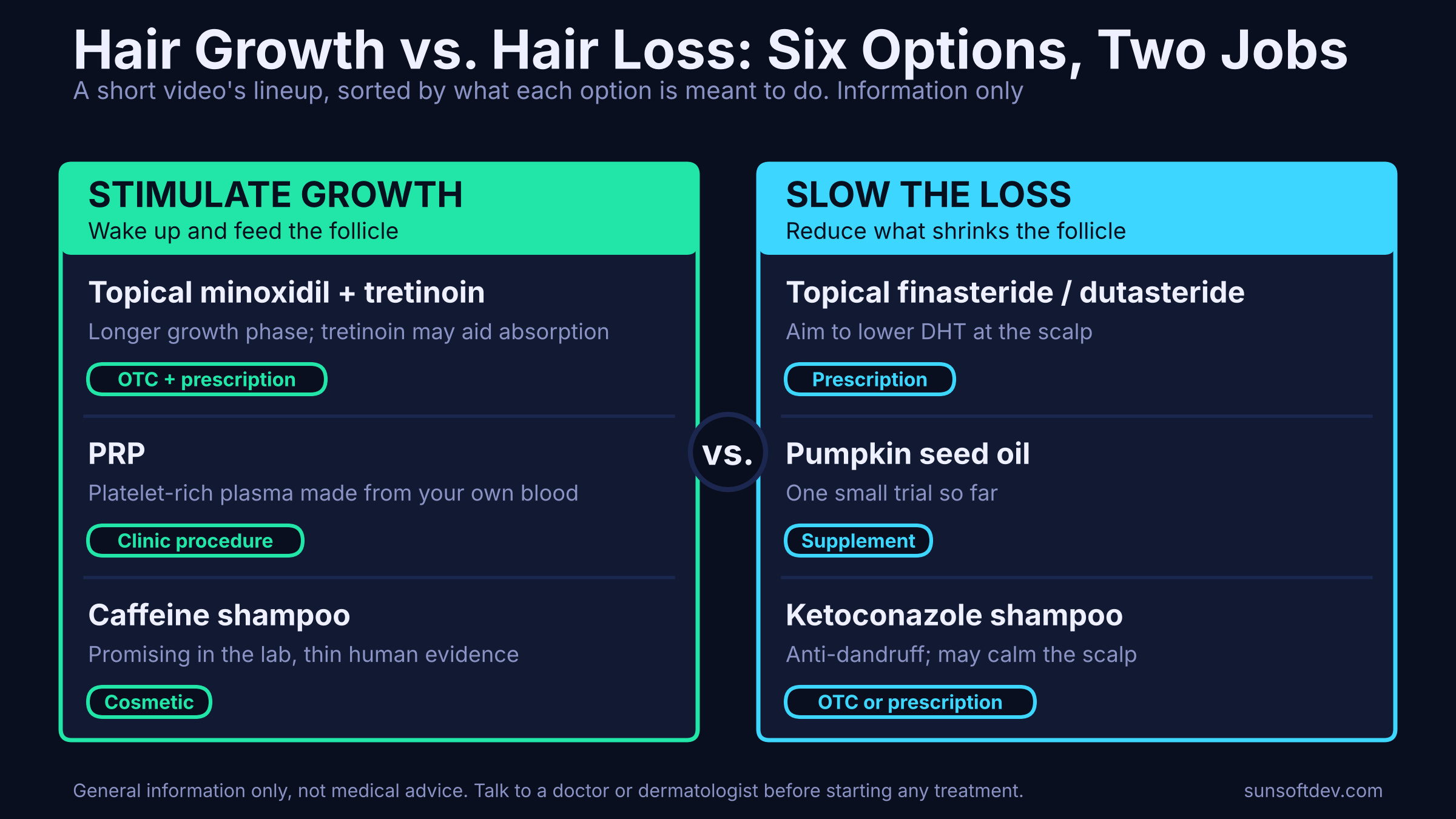
A short video has been circulating that sets two columns side by side. One is labeled "hair growth" and lists topical minoxidil with tretinoin, PRP and caffeine shampoo. The other is labeled "hair loss" and lists topical finasteride or dutasteride, pumpkin seed oil and ketoconazole shampoo. It is a tidy way to start a conversation, but the labels hide an important point: these six options are not all trying to do the same thing.
This article takes the same six items and looks at them calmly. We read the video's right-hand column as options meant to slow the loss, and the left-hand column as options meant to stimulate growth. That reading is our interpretation, not a claim from the video. For each one we cover what it is, how mature the human research looks, and what is worth asking a professional.
First, why hair thins at all
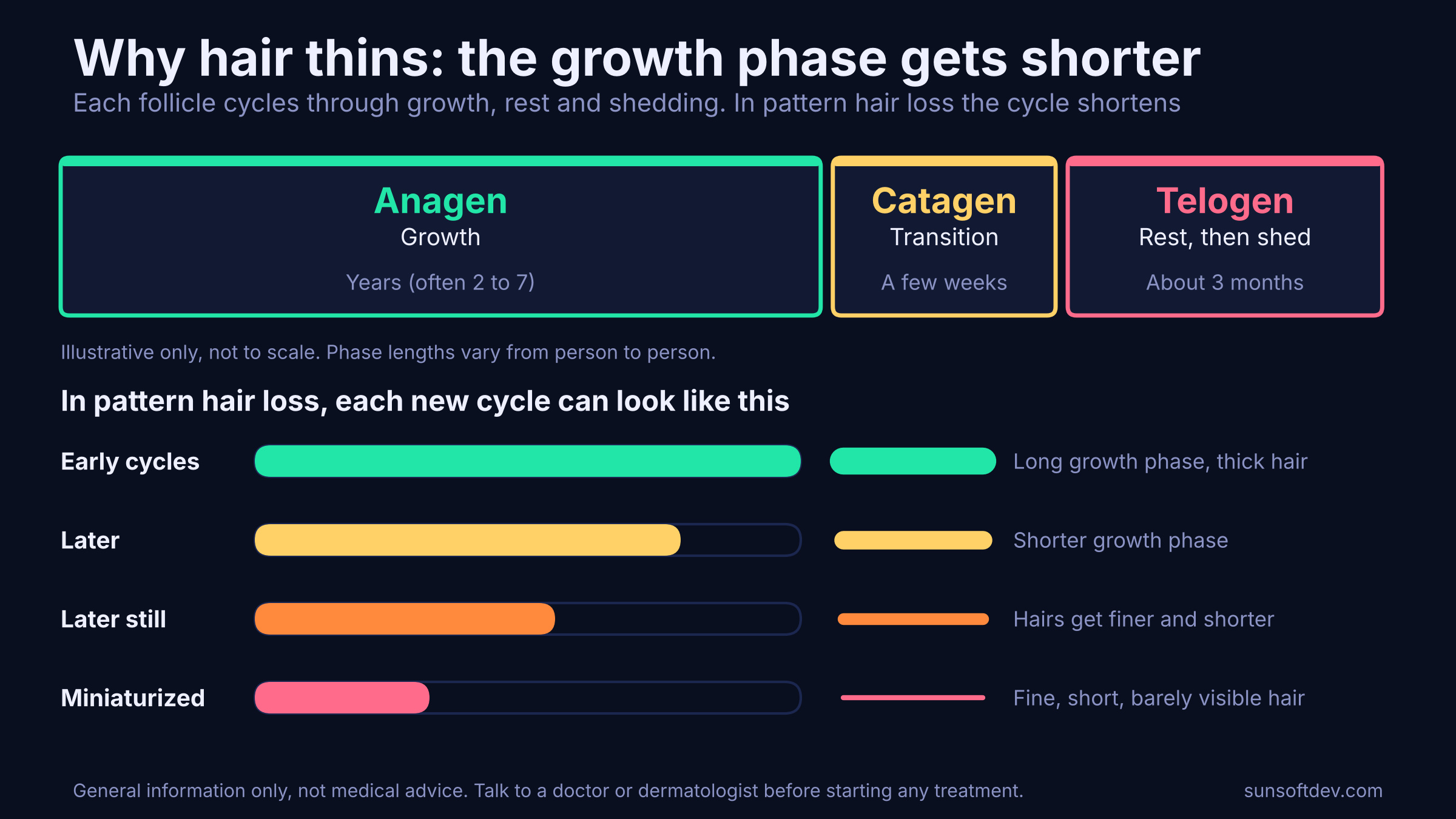
Every hair follicle runs on a repeating cycle. A long growth phase (anagen) lasts years. A short transition phase (catagen) lasts a few weeks. A resting phase (telogen) lasts a few months, after which the hair sheds and the cycle begins again. At any moment, most scalp hairs are in the growth phase.
The most common form of thinning is pattern hair loss, also called androgenetic alopecia. In people who are genetically sensitive, follicles gradually respond to a hormone called DHT. Each cycle, the growth phase gets shorter, the follicle shrinks, and the hair that grows back is finer and shorter. Eventually some follicles produce hair that is barely visible. This process is called miniaturization.
Pattern hair loss is not the only cause of thinning. Heavy shedding a few months after a major illness, a stressful event, rapid weight loss or childbirth is common and often settles on its own. Thyroid problems, low iron, some medicines and autoimmune conditions such as alopecia areata can also cause hair loss, and some scarring conditions can destroy follicles permanently. Because the right approach depends on the cause, a proper diagnosis matters more than any product choice.
Two different jobs
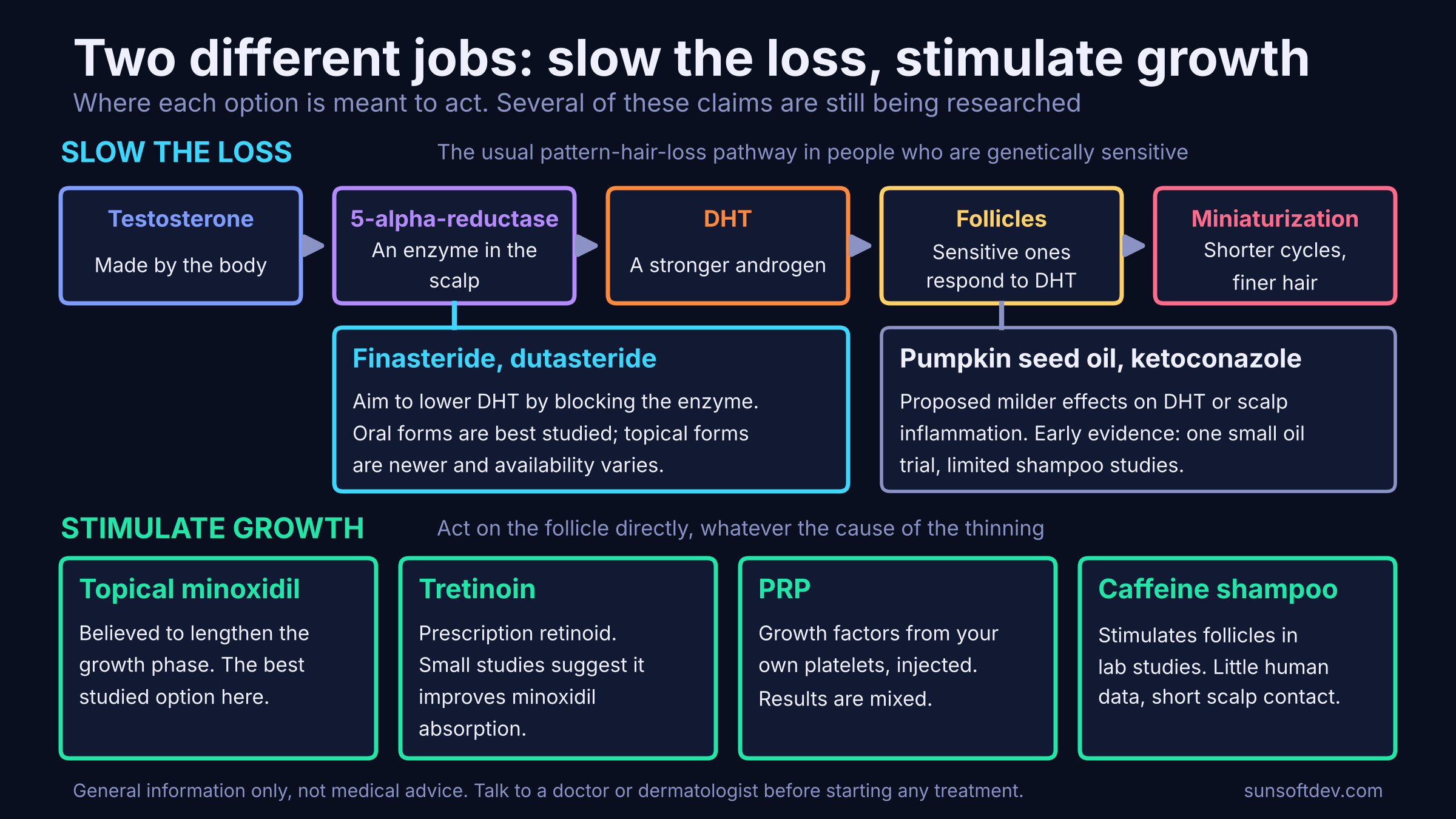
This is the idea the video's two columns point toward. Some options aim to slow the loss by reducing the hormonal signal that shrinks follicles. Others aim to stimulate growth by acting on the follicle directly. In practice, doctors often discuss the two jobs together, because holding on to the hair you have and thickening what remains are different goals.
The six at a glance
| Option | Main job | How it is sold or given | How mature is the human research? |
|---|---|---|---|
| Topical minoxidil | Stimulate growth | Over the counter in many countries | Several randomized trials |
| Tretinoin added to minoxidil | Stimulate growth | Prescription, off-label use | Small studies |
| PRP | Stimulate growth | Clinic procedure | Many small trials; methods vary |
| Caffeine shampoo | Stimulate growth | Cosmetic | Mostly lab studies |
| Topical finasteride or dutasteride | Slow the loss | Prescription; availability varies | Finasteride: promising trials. Dutasteride: very limited |
| Pumpkin seed oil | Slow the loss | Supplement | One small trial |
| Ketoconazole shampoo | Slow the loss (possibly) | Over the counter or prescription | Limited studies |
Stimulate growth
1. Topical minoxidil, with or without tretinoin
Minoxidil is applied to the scalp as a liquid or foam. It is sold over the counter for pattern hair loss in several countries, including the United States, and it is the best studied option on this list. Scientists do not fully understand how it works, but it is believed to lengthen the growth phase and increase the size of follicles. It does not address the hormonal cause, so it is generally understood to work only while it is being used.
Things people commonly report or are advised to watch for:
- Scalp itching, dryness or irritation. Some people react to the liquid base and switch to a foam, which is a conversation for a pharmacist or doctor.
- Extra shedding in the first weeks to months, which some people notice as the cycle resets.
- Unwanted hair on the face or hands if the product drips or is touched and spread.
- Rarely, dizziness, a racing heartbeat or swelling. These are reasons to stop and seek medical care.
- Minoxidil is harmful to cats and some other pets that come into contact with it. Keep it away from them.
Tretinoin is a prescription retinoid. Some small studies suggested that adding it to minoxidil can improve how well the scalp absorbs minoxidil, and some dermatologists prescribe the pairing off-label. Tretinoin can cause dryness, peeling and sun sensitivity, and it is not suitable during pregnancy. This is the kind of combination that should only be used under a clinician's direction.
2. PRP (platelet-rich plasma)
PRP is a clinic procedure. A small sample of your own blood is spun in a centrifuge to concentrate the platelets, and the resulting plasma is injected into the scalp. The idea is that growth factors released by platelets may support follicles.
Several small randomized trials and reviews report improvements in hair density for some people with pattern hair loss. The difficulty is that clinics use very different methods: different platelet concentrations, numbers of sessions and spacing, and different ways of preparing the sample. That makes the results hard to compare and hard to predict for an individual. PRP is usually given as a series of sessions, is often not covered by insurance, and can cause pain, swelling or headache. Rare complications include infection. Ask the clinician what training they have, what the full course would involve, and what the total cost is.
3. Caffeine shampoo
Caffeine got attention because laboratory experiments on hair follicles in culture found that it could offset some of the growth-suppressing effect of testosterone. That is an interesting result, but it is not the same as showing that a shampoo works on a human scalp. A few small human studies of caffeine shampoos and lotions exist, some funded by manufacturers, and they report modest effects at most. A shampoo is also rinsed off within minutes, which limits how much caffeine reaches the follicle.
If someone enjoys a caffeine shampoo as a harmless addition to a routine, that is a personal choice. It is best seen as supportive, not as a replacement for anything with stronger evidence.
Slow the loss
4. Topical finasteride or dutasteride
Both are 5-alpha-reductase inhibitors, meaning they block the enzyme that converts testosterone to DHT. That targets the hormonal cause of pattern hair loss directly.
Oral finasteride is approved for male pattern hair loss in many countries and has the strongest evidence of any option here for slowing the loss. Topical finasteride is newer. Clinical trials, including trials of spray forms, have reported encouraging results, but its regulatory status varies by country, and in some places it is only available through compounding pharmacies. Studies suggest the drug still enters the bloodstream when applied to the skin, although blood DHT generally falls less than with tablets.
Dutasteride blocks two forms of the enzyme instead of one. Oral dutasteride is approved for hair loss in a few countries, including South Korea and Japan, and is used off-label elsewhere. Evidence for topical dutasteride is very limited.
These are prescription medicines with real considerations:
- Some people report sexual side effects or mood changes, including low mood, while taking them. Regulators have added warnings about these effects. Anyone with a history of depression or anxiety should discuss that openly with a doctor first.
- They lower a blood test called PSA, which is used to screen for prostate problems. Tell any doctor who orders that test.
- Women who are pregnant or may become pregnant should avoid handling them, because of the risk to a developing baby.
- They are not used the same way in women. A doctor should guide any decision.
5. Pumpkin seed oil
Pumpkin seed oil is a supplement, often sold as softgels. It appears in hair conversations because of a randomized, placebo-controlled trial published in 2014 by Korean researchers. About 76 men with mild to moderate pattern hair loss took the oil or a placebo for 24 weeks, and the oil group had a larger average increase in hair count. Laboratory work has also suggested it might weakly inhibit the same enzyme that finasteride targets.
That is a promising start and a thin foundation. It is one small trial, and it studied oral use, not applying oil to the scalp. Supplements are not tested as thoroughly as drugs, product quality varies, and people with seed allergies should be careful. It is an option to mention to a doctor, not a proven alternative to a medicine.
6. Ketoconazole shampoo
Ketoconazole is an antifungal ingredient used in anti-dandruff shampoos. It is sold over the counter in lower strengths and by prescription in higher strengths in some countries. It earns a place in hair-loss discussions because dandruff and scalp inflammation can make shedding look worse, and a few small studies have suggested it may help hair density or follicle size, possibly by calming inflammation or through a mild anti-androgen effect. One often-cited study compared it with minoxidil, but studies are small, and it has not been established as a stand-alone treatment for pattern hair loss.
Follow the product label for how often and how long to use it. Some people notice dryness or scalp irritation, and occasionally changes in hair texture.
How strong is the evidence, side by side?
The chart below is a simplified editorial view. It is meant to show research maturity, not how well anything will work for you.
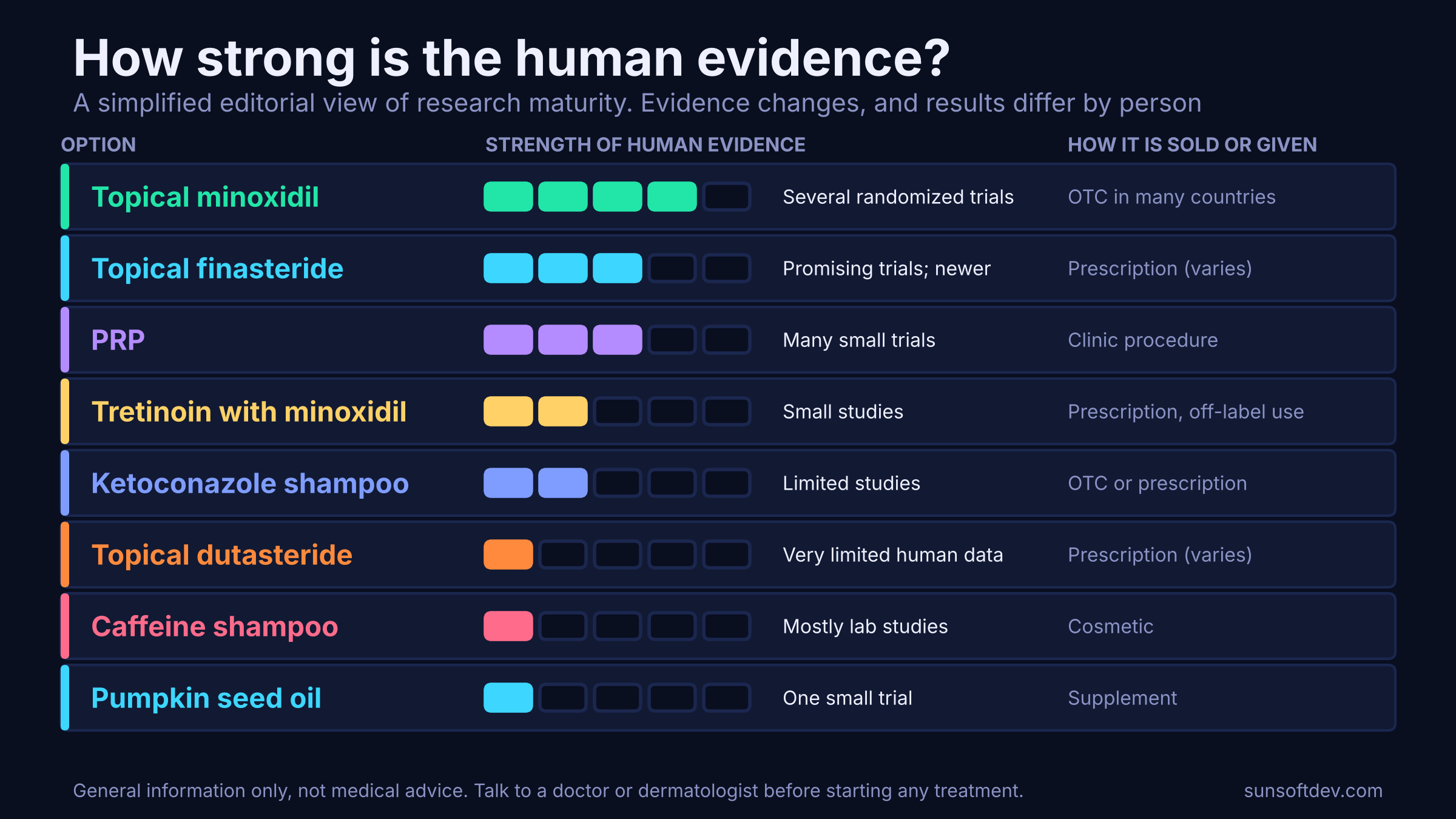
Two points are worth keeping in mind. First, evidence strength and a good personal outcome are not the same thing: a well-studied option still does not work for everyone. Second, a weaker evidence rating does not mean something is harmful. It means we know less, so the honest claim is a smaller one.
A realistic timeline
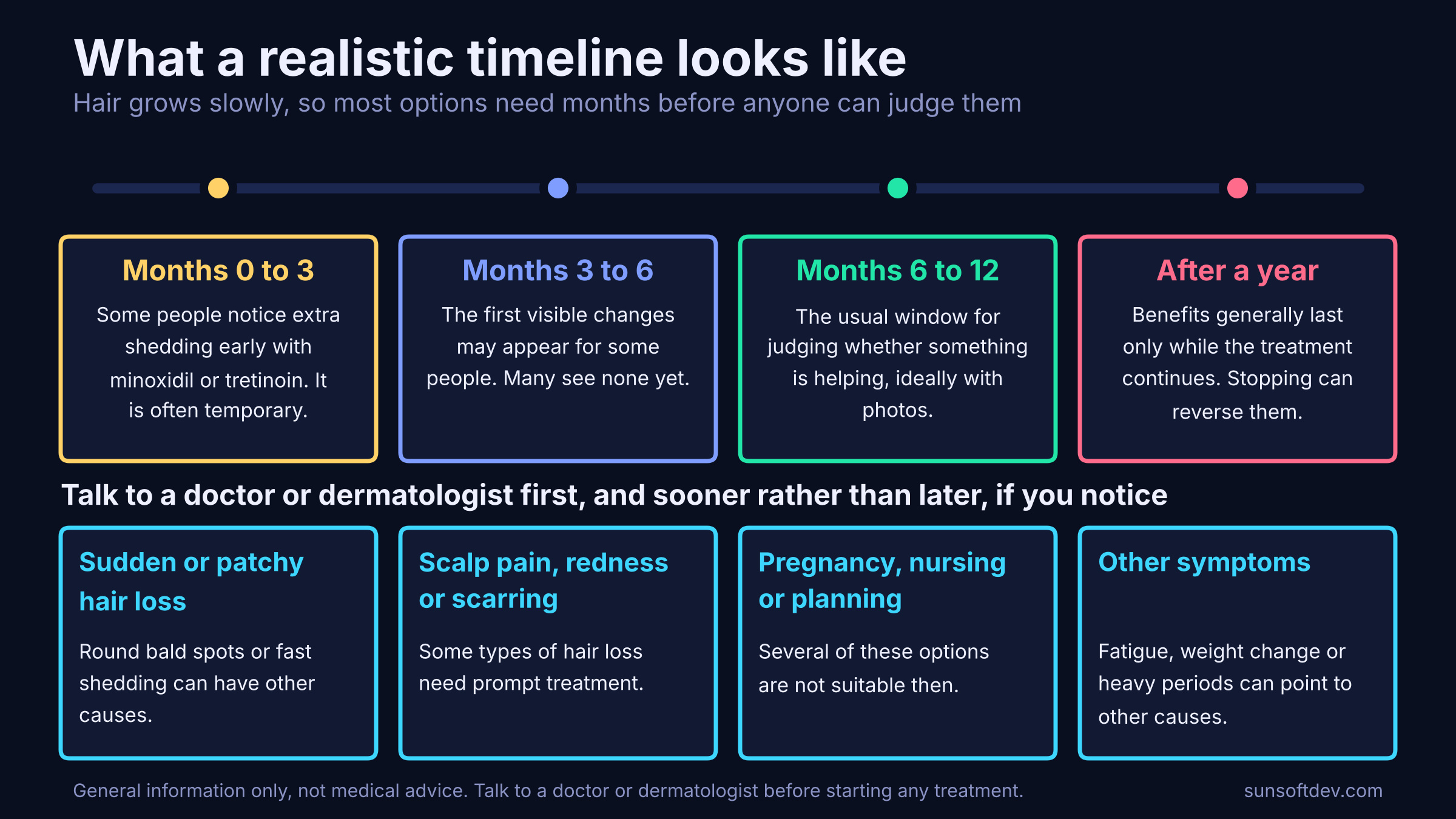
Hair grows slowly, which is why every option here needs months before anyone can judge it. Early extra shedding can happen. First visible changes, if they come, often appear after several months. Many clinicians suggest judging results after about six to twelve months, using photos taken in the same light. For options that work by ongoing treatment, such as minoxidil and the 5-alpha-reductase inhibitors, benefits are generally understood to fade if the treatment stops.
When to talk to a professional first
Some patterns call for an exam before any product:
- Sudden loss, round bald patches or very fast shedding.
- Scalp pain, burning, redness, scaling or scarring.
- Pregnancy, nursing or planning a pregnancy.
- Hair loss alongside other symptoms such as fatigue, weight change or irregular periods.
- Any history of depression or anxiety, liver or heart problems, or regular prescription medicine, before starting a prescription option.
Useful questions to bring: What type of hair loss is this? What does the evidence look like for each option you would suggest for me? What are the side effects, and what should make me stop? How long should I try it before deciding, and what happens if I stop?
The bottom line
The viral video's two columns are a handy summary, but the real lesson is that hair loss is two problems, not one. Slowing the loss and stimulating growth are different jobs, the evidence behind the six options varies a lot, and the best-supported choices are the ones that need a professional's guidance. Sleep, nutrition, stress and any underlying health condition also matter, and no product replaces getting the cause checked.
If thinning worries you, a dermatologist visit is a better first step than choosing from a video.
Resources
This article is general information only and is not medical advice. It does not diagnose, treat, cure or prevent any condition or recommend any product. Always consult a qualified healthcare professional about your own situation.